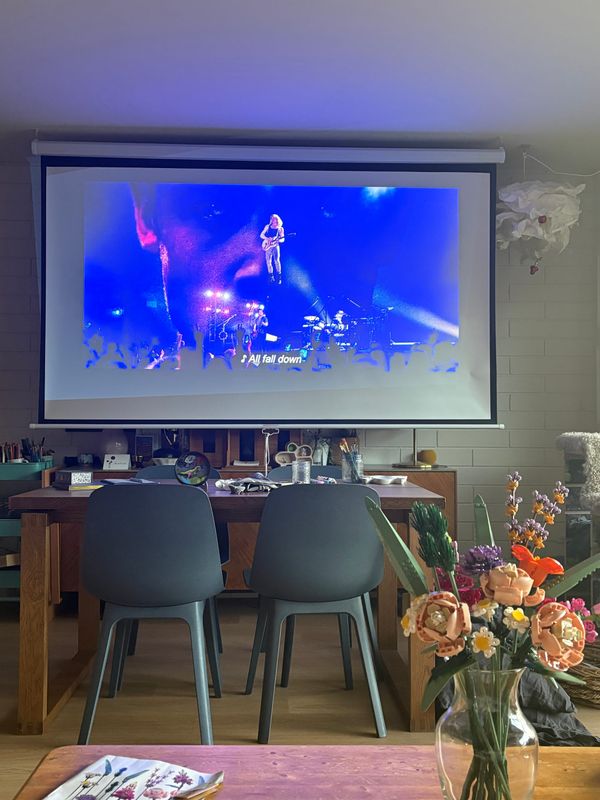
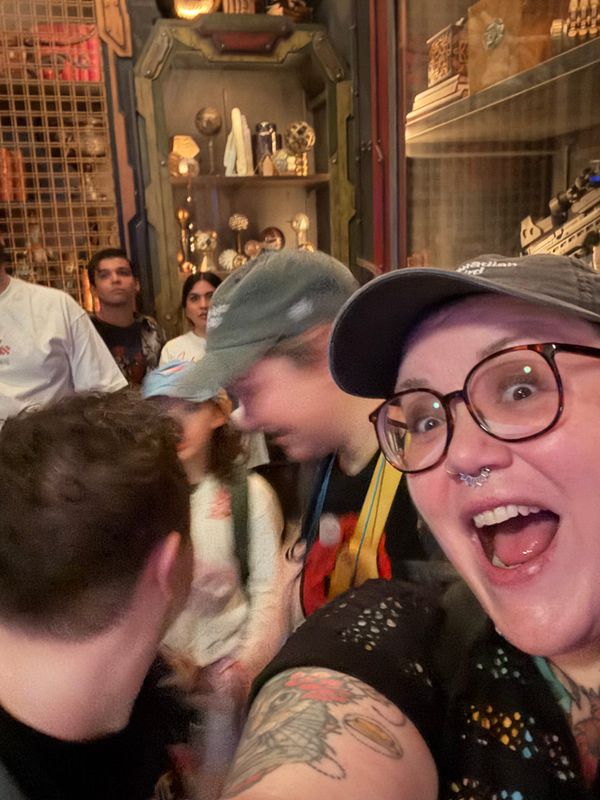
July (it never seemed so strange)


WHAT A MONTH. We had our choir shows (thanks to those pals who came and especially to those pals I sing with; singing with people is the biggest magic I know how to make and I'm so grateful for it!), then I went to Banff for two weeks for my first ever writing residency, then came home in time to keynote a conference. I also formally announced the closure of the SFU Publishing Program, which, now that it's public, can conveniently be my answer any time someone asks why I look like I aged a century over the past three years.
Here's some other stuff I did this past month!
In July Material Girls took a little break, after one last episode about Obsession as an example of incel horror:
With all that extra time, Gaby and Zoe and I finished up our The Vampire Lestat watch-along, with Marcelle showing up as a special guest for episode 5!
There will be a few bonus episodes coming in August, as well as a return to our regularly scheduled programming, beginning with a Material Girls episode about The Odyssey (the poem, not the movie, which I still haven't seen because I've been too busy having other kinds of fun, like going to the beach).
My episode of the new season of Hot & Bothered also dropped this month! I haven't listened back but I'm probably very funny and charming on it.
I have absolutely nothing to plug for the month of August because I plan on working as little as possible, swimming as much as I can, and generally fucking off in anticipation of The Great Fucking Off aka the end of my term as Director, which as I'm writing this is 36 calendar days or 26 working days, NOT THAT I'M COUNTING.
This is a long one, but I figured that I won't be sharing this keynote anywhere else since it was written specifically for this event, so here it is!
Pixar, Core Memories, and the Anxiety of Childhood Malleability
Keynote for the 2026 UBC Master of Arts in Children’s Literature Graduate Student Conference
At the beginning of the 2015 Disney-Pixar film Inside Out, our narrator and protagonist Joy (voiced by Amy Poehler), introduces us to Riley, the child who Joy both is and is not:
Riley’s child mind consists of five key emotions, each of which has am important function: Fear keeps Riley safe, Disgust keeps Riley from being poisoned, and Anger cares about fairness. Joy doesn’t bother to explain her own function — the value of Joy is seemingly self-evident, even inevitable — and Sadness is similar. She’s just there, fucking things up.
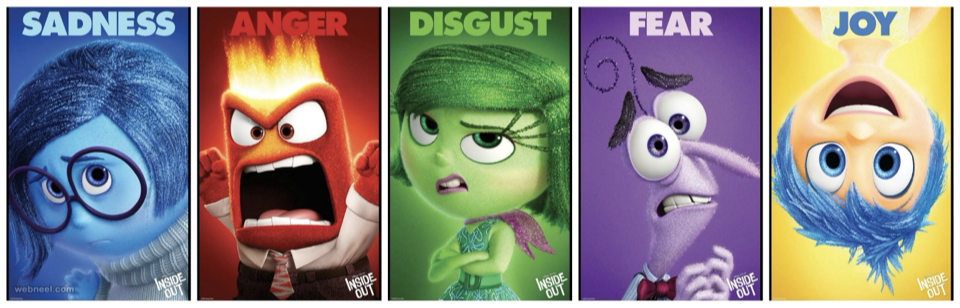
Inside Out has been celebrated for the simultaneous care and legibility with which it depicts how the brain operates. The creators famously consulted with psychologists and neuroscientists to get the basic functions of the brain right, while also creating a legible visual vocabulary for the relationships between emotions, experiences, memories, and identity that has made Inside Out a particularly helpful film for talking about feelings. Which, to be clear, we love. In order to render the theoretical functions of a developing brain as a three-dimensional space, Inside Out gives many inchoate things shape and personality. Emotions are not merely anthropomorphized, but are presented as adults and voiced by recognizable actors: in addition to Poehler as Joy, we have Phyllis Smith as Sadness, Bill Hader as Fear, Lewis Black as Anger, and Mindy Kaling as Disgust. Riley’s memories appear as glowing orbs, colour-coordinated to the dominant emotion that shaped that memory, slotting neatly into Headquarters’ open plan wall shelving before being downloaded each night into long-term storage. The exception is her core memories: five special memories that shape her identity with greater force than the others. Each core memory is associated with a floating island that represents some aspect of her personality; the islands are connected to Headquarters, where the emotions live, and that’s where the core memories are kept safe and sound until, you know, some narrative events unfold.
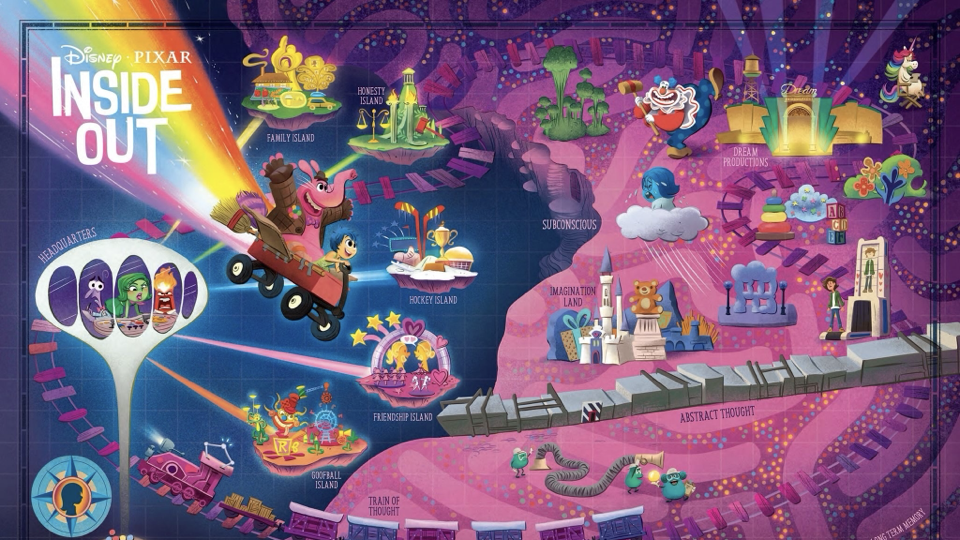
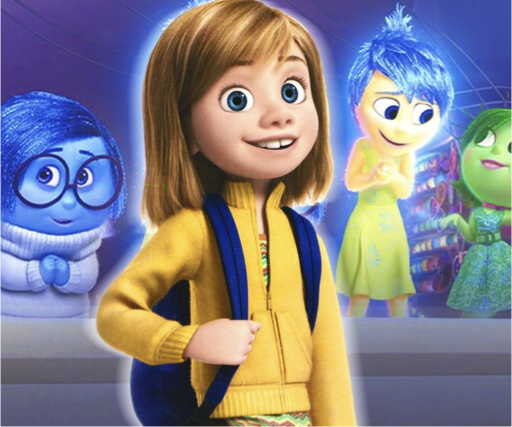
The design of the inside of Riley’s head is surprisingly mechanistic: pneumatic tubes, railways, gears, buttons, and levers all play significant roles in how the emotions operate Riley, like the Power Rangers controlling a Megazord. Riley becomes a mechanized figure herself; Director Peter Docter has described Riley as not the main character but the film’s setting. As the world in which the story takes place, Riley has a set of predictable functions that can be operated via interaction with various devices — right up until her functions cease to be predictable, and her inherent nature as a messy organic being entangled in a deeply complex world sends the peaceful operations of Headquarters into chaos. As the film progresses, it becomes increasingly clear that neither Joy nor any of the emotions were ever really in control; Riley is the sum of her parts but she is also in excess of those parts. Riley is familiar terrain to the emotions, right up until she isn’t.
~
Since at least the nineteenth century, literature as abounded on the problem of trying to shape children properly — particularly because early race science positioned children as uniquely susceptible to to influence both positive and negative. As Kyla Schuller explains in The Biopolitics of Feeling, impressibility — that is, susceptibility to being impacted, or shaped, by outside influences — was a characteristic associated with whiteness: it essentially meant that white people were more malleable, capable of evolving, and thus uniquely capable of civility (7). That malleability was both an advantage and a source of danger, expressed in narratives of white men “going native,” for example. And the period of greatest vulnerability was childhood.
Colonialism thus brought anxieties about risks of contamination. In Carnal Knowledge and Imperial Power, Ann Laura Stoler documents how Dutch settlers living in the colonial Indies were anxious their children would be shaped by this non-European setting in ways that might “undermine the moral tenets of European privilege and the security of rule” (Stoler 112). As a result, colonial powers sought to manage domestic arrangements and affective attachments as a means of upholding colonial categories of ruler and ruled. Domestic space was imagined as “the preparatory environment for civil responsibility” through appropriate parenting and moral education (120). Failure to properly manage one’s domestic space, including children, threatened to undermine the whole imperial project. The goals of household management and child rearing manuals of the time was to turn children into good imperial citizens who didn’t just know the right things, but also felt the right things. They had to love their nation and their whiteness. They had to believe in their innate superiority to the native children they played with and the native women who might be responsible for much of their care.
Childhood malleability wasn’t exclusive to white children, though. So powerful was this period of heightened influence that even a non-white child could potentially become civilized. This belief was used to justify violent abduction from their families as well as systematic attempts, on the part of imperial powers and colonial governments, to destroy their cultures.
The kinds of race science that shaped these imperial education projects had fallen out of vogue by the twentieth century, but they were replaced by new approaches to child-rearing that continued to focus on raising the right kind of citizens for the right kind of nation. Nicholas Sammond, in “Manufacturing the American Child: child-rearing and the rise of Walt Disney,” demonstrates that, in addition to pre-existing concerns about education and moral fibre, the early twentieth century brought new interests in the importance of play as part of childhood, as well as the significance of what kind of media children should be consuming.
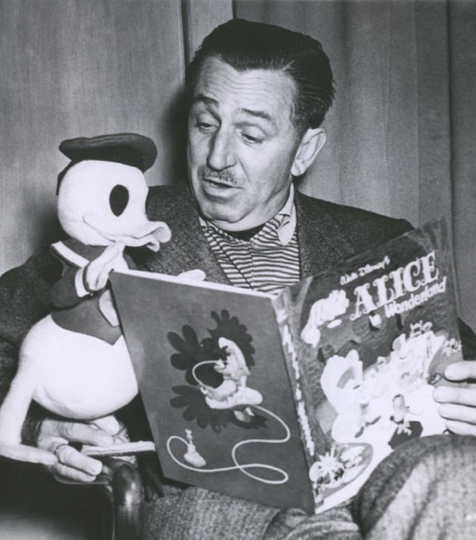
When Disney arrived on the scene in the 1920s, the meaning of childhood and its relationship to both the wellbeing of the American nation and the emergence of mass media were hot topics. As Sammond writes, parenting manuals and children’s media alike were concerned with “an idea of children as the locus of a controllable future in the midst of an uncontrollable present. It is a history of the belief that whoever controls the minds and desires of children controls their future as subjects and citizens—as consumers and (re)producers of American culture” (29). Disney (the man and the corporation) stood, according to Sammond, for “the meeting of artisanal practice and scientific management,” a place where the joys of childhood and its scientific study could go hand-in-hand. Sammond describes middle-class children of the period as both “cherished family pets” and “laboratory animals whose behaviours could be shaped through application of proper stimuli” (34).
Through close-readings of promotional materials from the period, Sammond demonstrates that marketing materials for Disney emphasized the company’s “Fordist industrial organization” in a way that mirrored “the quasi-professional, management-oriented child-rearing programmes of the time.” Creating an animated film became a powerful metaphor for raising a child, with both deploying “the latest scientific techniques of management, observation, and production in order to create the full range of human (and anthropomorphic) emotions and behaviours” (48). From this perspective, Inside Out’s well-publicized reliance on psychologists and neuroscientists is continuous with Disney’s history of aligning the production of their animated features with contemporary scientific understandings of how to best raise a child.
“But Hannah,” you might be thinking right now, “Inside Out isn’t a Disney movie, it’s a Pixar movie.” And you’d be right, except that, of course, Disney owns Pixar. There’s an Inside Out themed ride at the Disneyland Resort, though it’s located on Pixar Pier, at Disney California Adventure, across the way for the OG Disneyland. That physical distance and corporate proximity is a good metaphor for the relationship between Disney and Pixar: Pixar has been fully subsumed by the Disney corporation, but it maintains something of its own identity, and Pixar movies have their own characteristics: they’re computer-animated, for one, and the difference between traditional, hand-drawn animation and computer animation is central to Disney and Pixar’s relationship.
Reading more about how important the artisanal dimensions of hand-drawn animation were to Disney’s early corporate identity helped me to understand something I’ve been pondering since my long-term collaborator Marcelle Kosman and I made an episode of our podcast, Material Girls, about Pixar. During the process of researching that episode, I learned that John Lasseter had originally been fired from Disney in the 1980s for pushing computer animation too hard. The reasoning behind that firing, as far as I can tell, had a lot to do with that blending of “artisanal practice and scientific management” that Sammond describes. On the management side, animation studios were huge, complex production machines with strict hierarchies: you were expected to spend a bunch of time as a cog in the machine, hand-drawing backgrounds or whatever, before you could rise to a position from which you might suggest (gasp) changes. But also, for all the technologies of management involved in Disney animation, the movies were ultimately hand-drawn, and there was an anxiety that incorporating computers into the production process would destroy the magic of the films.
Pixar proved this worry wrong with the break-out success of Toy Story in 1995, and ultimately Disney acquired Pixar in 2006, with John Lasseter returning in triumph to become the chief creative officer of Pixar Animation Studios, Walt Disney Animation Studios, and Disneytoon Studios, as well as the principal creative advisor for Walt Disney Imagineering… until he was ousted in 2017 after multiple accusations of sexual misconduct. Still, making the one guy who had been super pro-computer animation the new creative head of both Pixar and Disney sent a clear signal that the two companies had functionally become one.
And yet Pixar movies have maintained their own defining characteristics, even beyond the clear through-line of computer animation. Disney movies are more likely to include a romance storyline and a larger-than-life villain; they tend to be Broadway-style musicals, and they’re often based on classic IP like fairy tales. Pixar movies focus on friendship over romance, internal struggles rather than villains, and telling original stories rather than adapting familiar ones. Also, the characters usually don’t sing. During a recent rewatch of some of my favourite Pixar movies, I noticed another through-line: a kind of chaotic anxiety about the wellbeing of children, with an emphasis on the elaborate processes, technologies, and/or schemes involved in producing that wellbeing, ideally out of the sight of the child. Take the founding franchise, Toy Story, for example. A cast of adult-voiced toys undertake ever more elaborate quests in pursuit of the maintenance of childhood innocence. In Monsters, Inc. we learn about the almost explicitly Fordist factory where monsters clock in to extract childrens’ screams, the fuel that powers their civilization. Doesn’t that feel like a metaphor for the anxious labour of endless hours producing animation in order to craft ideal childhood experiences? Particularly in cases where, as with early computer animation, the actual material realities of that labour had to be concealed lest its banality destroy the “magic”? And so instead we get recurring stories in which children’s affect is being produced by anxious adults, yes, but don’t worry, they’re producing it in the right kinds of ways: in the good old-fashioned American factory, with time cards and hard hats and cogs and pulleys and levers.
If some characteristics of Pixar movies seem to be about an anxious relationship to their newfangled conditions of production (which of course aren’t all that newfangled any more; lots of Disney moves are now computer animated), others embrace the affordances of what computer animation can do that hand-drawn animation could not. In traditional animation, a two-dimensional background is drawn and then a character is placed onto it. Perspective must be chosen from the beginning, because the image is being depicted, like a painting, from a specific angle. In computer animation, the physical space of the world is rendered in three dimensions and then characters are placed inside that space. Shots are taken from within that rendered space, more like how films are made in actual meat-space. The rendering of extremely specific spaces, characterized by a heightened sense of “insideness,” follows from this technology — a child’s bedroom becomes the entirety of the world, for example, but so does the seabed, or even the inside of a child’s mind. But so does a utopian desire to burst out of this constrained space, like bursting through the two dimensions of animation into a third.
This utopian impulse is one of the key characteristics of a set of films that theorist Jack Halberstam, in his 2011 book The Queer Art of Failure, calls “Pixarvolt.” This subset of Pixar films, Halberstam argues, have a surprising interest in “the themes of revolution and transformation” (29). Notably, not all Pixar films are Pixarvolt; he excludes The Incredibles and Happy Feet for being too fixated on the triumph of the remarkable individual. But, while The Queer Art of Failure came out four years before Inside Out, I’m certain that Halberstam would have included Inside Out in the Pixarvolt canon.
For one thing, Pixarvolt movies tend to feature strange, non-human characters that challenge how we think about the nature (and the naturalness) of humanity. Earlier I distinguished between Riley as a mechanized figure with a set of predictable functions and Riley as a messy organic subject, aligning that mechanized version with a more conservative view of childhood that responds to the child’s malleability by seeking to shape and control them. Sammond’s discussion of Disney as furthering the scientific discourses of proper child-rearing in the early 20th century — treating the child as lab rat — supported that reading. But Halberstam evokes the figure of the cyborg in a way that fucks with my tidy binary altogether. Here’s what he writes:
An animated self allows for the deconstruction of ideas of a timeless and natural humanity. The idea of the human does tend to return in some form or another over the course of the animated film, usually as a desire for uniqueness, or an unalienated relation to work and to others, or as a fantasy of liberty, but the notion of a robotic and engineered self takes the animated feature well into the genealogical territory of Harawayesque cyborgs.
Halberstam is alluding, of course, to scholar of feminist science and technology studies Donna Haraway and her iconic essay “A Cyborg Manifesto.” Haraway’s cyborgs are critiques of the capitalist, patriarchal self, breaking down the borders between human and animal and between human and machine. The cyborg self contains multitudes; it blends natural and unnatural, self and other, and in this way opposes Western modernity’s fixation on individualism, uniqueness, and personal liberty.
At the beginning of the movie, Joy, our narrator and protagonist, doesn’t just imagine Riley as malleable; she imagines Riley as malleable by Joy in particular, over and above the other emotions. Joy is part of a team, but she’s the leader; she holds herself outside and above the others. The arc of her journey is about recognizing her role within a necessary collective. The revelation of Sadness’s function is particularly aligned with what Halberstam observes of Pixarvolt movies’ tendency to tell “intricate stories of collective action, anticapitalist critique, group bonding, and alternative imaginings of community” (43-44). The revelation of Sadness’s purposes — what she does for Riley — is the narrative climax of Inside Out: Sadness tells people around Riley that she needs them. Sadness, that weird mopey little loner, turns out to be the most fundamentally relational emotion on the team.
Thinking of Riley as a cyborg figure helps to make sense of the tension between her function as a machine the other characters are controlling and her existence as a distinct self; it becomes possible to see her as a child who is both malleable and uncontrollable, who is at once familiar and unfamiliar terrain. Inside, Riley is not only gears and pneumatic tubes and railways with schedules, but also men and women and weird little androgynous bean-shaped guys who, like the monsters in Monsters, Inc., wear gratuitous hard hats and make references to clocking out. Riley is uncontrollable because she is a multitude, and that multitude is engaged in all kinds of activities, including, crucially, forgetting. Let’s watch another short scene together. In this one, Joy and Sadness encounter a pair of Mind Workers in the process of consigning memories to “the dump.”
What this clip depicts is in part a natural process — our brains are constantly forgetting some things in order to clear up space to remember others. Learning is as much about forgetting as it is about remembering. But forgetting can also be a component of radical political projects; Halberstam describes it as “a useful tool for jamming the smooth operations of the normal and the ordinary” (70), one that “allows for a release from the weight of the past and the menace of the future” (83). The radical potential of forgetting as a means of creating queer futures is most clearly communicated via the figure of Bing Bong, Riley’s imaginary friend.
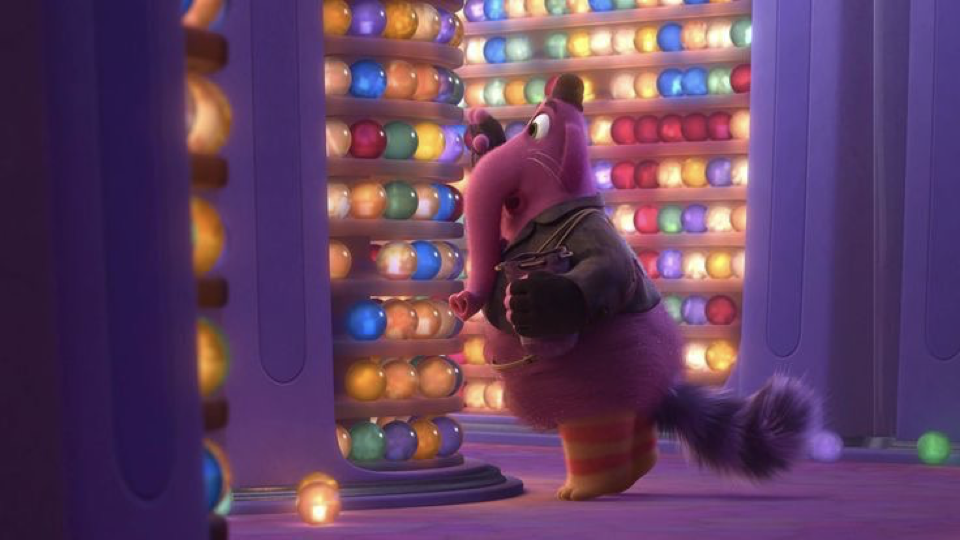
A mix of cat, elephant, dolphin, and Borsht Belt comedian, Bing Bong is made of cotton candy and voiced by Richard Kind. Joy and Sadness find him living in long term memory, scavenging childhood memories from the shelves, a fugitive queer in Riley’s subconscious. Under the guidance of Bing Bong, Joy and Sadness journey through Abstract Thought and Imagination and Dream, moving further and further out of the rational realms of Riley’s mind and into unfamiliar territory where Joy’s fantasies of control get ever more unravelled. Panicked by the ongoing collapse of Riley’s personality islands, Joy abandons Sadness to prioritize her own return to Headquarters, which directly results in Joy and Bing Bong being plunged into the Memory Dump, doomed to be forgotten forever. It’s in the Memory Dump that Joy discovers the true relational role that Sadness plays in communicating Riley’s need for others, and recognizes that she must allow Sadness to be present in Riley’s core memories. And it’s there, amidst dissolving early childhood memories, that Bing Bong sacrifices himself so Joy can escape.
Literally, at a narrative level, Bing Bong is forgotten, his memory a sacrifice for Riley’s futurity. But within the complex cyborg architecture of Riley’s mind, he is also, crucially, remembered, by both Joy and Sadness. His memory and his forgottenness are what allow for Joy and Sadness’s reunion, for the creation of a new form of collectivity between these two seemingly opposed emotions. Out in the “real world,” Riley may not remember her imaginary friend, but she’s finally able to cry in front of her parents, to push away the received imperative to be happy at any cost. His is a forgetting that will be remembered.
~
As I rewatched Inside Out most recently, in a hotel in Banff, Alberta, I started thinking about the collective nature of memory work. My mother was the memory worker of my family, and when she died in 2000, the creation and documentation of collective family history ceased. What remains is the archive she was able to put together during her illness: an inconsistently updated set of journals and manila envelopes scrawled with time markers to help her organize photographs, an incomplete project that has left hundreds of pictures unsorted.
I have, perhaps inevitably, become the keeper of my mother’s incomplete archive, of her journals and manila envelops. All family photos are given to me as though they are my inevitable due. I am the one who decides which are saved and which thrown out. Women, mothers especially, are usually the memory keepers of their families. In their absence, shared history splinters and fragments, disappearing without the reinforcement of collective recollection. It’s not just that there’s no one to ask, but also that, without her centrifugal force, we have not done the work of maintaining our memories. As a result, I remember very little of my childhood, and I have no one to help me retrieve what I have lost. I can attempt to piece things back together from the archive, but my childhood is a like a moth-eaten shawl, more scrap than fabric. Rewatching Inside Out, I find myself wondering if one day one of Riley’s parents might say to her, “remember Bing Bong?” and then she will.
I wonder if my own relationship to childhood forgetting is what initially made me suspicious of the idea of “core memories,” when I saw the concept begin to creep beyond the film and into the world of parenting advice, shifting from a description of the brain’s function to a new language for describing children’s malleability. This concept, dreamed up by Pixar, has made its way into pop psychology and parenting advice with a soupçon of irony: while the movie follows Joy’s obsession with controlling Riley’s childhood memories, and her ultimate recognition that she cannot and should not do so, the creation of positive core memories has turned into an expectation for parents. “If You Have These 11 Core Memories, Your Parents Did A Great Job Raising You.” “Core Memories with Children: A Guide to Strengthening Family Bonds.” “Psychologist shares the 5 ‘core’ memories your child will cherish.” Maybe this twisting of the film’s message shouldn’t be surprising. After all, anxieties about the malleability of children continue into our contemporary moment, if anything in a heightened form given the proliferation of the Parenting Advice Industrial Complex. And, considering its enduring association with the production of an ideal American childhood, Disney has more to gain than it does to lose in this idea that core memories are something you can produce, particularly by taking your children on a Disney cruise or to a theme park, where they might form a core memory by riding on the Inside Out themed “Emotional Whirlwind.”
But, as a child of forgetting, I resent the idea that core memories can be successfully installed into a child like a software program. And as a queer adult, I resent the idea of children as controllable altogether. Drawing on the work of Kathryn Bond Stockton, Halberstam argues that childhood is inherently queer; for proof, you need look no further than all the coercive attempts to make children straight:
If we were all already normative and heterosexual to begin with in our desires, orientations, and modes of being, then presumably we would not need such strict parental guidance to deliver us all to our common destinies of marriage, child rearing, and hetero-reproduction. If you believe that children need training, you assume and allow for the fact that they are always already anarchic and rebellious, out of order and out of time.
So many classic Disney properties contribute to this training in compulsory heterosexuality, most notably via the omnipresence of princess characters whose happy endings consist of marriage to a prince. As many scholars of Disney have pointed out, the entire corporate machine functions as a lesson in how to want the right kinds of things in the right kinds of ways. In “Disney’s pedagogies of pleasure and the eternal recurrence of whiteness,” for example, Jennifer A. Sandlin and Julie Garlen Maudlin argue that Disney leans heavily on affect in their marketing strategies:
From parks to movies to deluxe cruise line vacations, The Walt Disney Company goes to great lengths to create intricately fabricated fantasies of pleasure and fulfillment that promise an escape from the realities of our everyday lives. In this way, Disney operates in what Jenkins (2006) described as an ‘affective economy,’ a system in which emotions act as a driving force for marketing goods and services and consumer viewing and purchasing decisions. … [T]he emergence of affective economies marks a shift in mechanisms of control within late capitalism, as ‘forms of ideological manipulation give way to the modulation of affect’ … In this context, affect is produced, circulated, commodified, and consumed within complex networks of goods and services.
Disney is all about how it can make you feel — hence the Disneyland nickname “The Happiest Place on Earth.” How, then, to make sense of the fact that one of Pixar’s highest grossing films of all time — and thus one of Disney’s own blockbuster successes — is an extended critique of coercive happiness and fantasies of being able to deliberately shape or control children? How is it that Disney can be at once the producer of queer and chaotic childhood stories like Inside Out and a primary site for the monetization of parental anxiety about engineering “core memories”?
A version of this question has been asked by fans and scholars of Disney alike for many, many years. It’s another version of: how can I like this when I can also see that it is Bad? Ryan Bunch, in his entry on Disney in The SAGE Encyclopedia of Children and Childhood Studies, offers a helpful summary of these debates:
Some regard Disney as more or less irredeemably corrupting, while others have a great deal more faith in the ability of fans and consumers to make their own meanings of Disney texts. Still others take a more nuanced view, describing Disney’s fans, both adults and children, as collaborators in Disney’s construction of its own image and that of childhood. […] Where children’s agency is emphasized, theories of play have been useful in showing how children make their own uses and interpretations of Disney texts as part of their folklore or creative play culture, even as Disney, to some extent establishes the meaning and parameters of creativity through the influence of its branding machine.
Perhaps it’s because in my heart I agree with Althusser that there is no outside to ideology, but I’m okay with the idea that the parameters of creativity might be influenced by Disney’s branding machine. There is always a horizon to our imaginations, and children and artists alike are always pushing past that horizon to discover what else is possible. What I see in Pixar movies like Inside Out, alongside newer films like Turning Red and Luca, is ample space for the queer child as a figure who resists and exceeds attempts to shape them into model individuals. And these stories feel more vital to me than ever, in the context of our fascist present, in which the gender-non-conforming child has become the centre of a moral panic over “parental rights” and gender non-conformity as social contagion.

In 2024 and 2025, my aforementioned collaborator Marcelle Kosman made two seasons of Gender Playground, a podcast dedicated to the joys of gender-affirming care for kids. Her cohost was her long-time friend Raimi Marx, a genderqueer and disabled Mental Health Counselor whose “guiding star in working towards a more joyful and affirming world is to ‘be the person you needed when you were younger.’” I’m going to play you the opening anecdote from the very first episode of Gender Playground, titled “Gender Euphoria,” because — well, you’ll hear why.
I took my daughter Billy to Disneyland recently and, for reasons unnecessary to this story, we found ourselves in Bibbidi Bobbidi Boutique. Bibbidi Bobbidi Boutique provides princess makeovers for children. It also does knight makeovers, but its name references Cinderella’s fairy godmother dressing her up for the ball, so princess stuff is kind of it’s main draw.
Now, my daughter Billy is not really into princess stuff; she’s going through a real “weapons” phase right now? We were at the Boutique specifically looking for a Black Panther costume and when the Boutique didn’t have one, I thought maybe Billy would be interested in Mirabel’s dress from Encanto, or in an outfit to dress up like Raya from Raya and the Last Dragon. Honestly, if she had expressed even the slightest interest in an outfit from Frozen, I would have been skeptical, but I’d have gotten it for her. Instead, though, she was drawn like a moth to a flame to the ittiest bittiest corner of the shop with like six knight accessories, and, once there, she begged me for a foam helmet, a shield, and a sword.
I don’t know why this surprised me; she has a shield and a sword and a full knight costume at home and she plays with them all the time. And because she already has stuff like this, I tried to convince her that she didn’t need any more knight stuff.
This, in my experience, is a normal part of parenting: telling my child “you already have something that does this, you don’t need another.” But, that’s not exactly what I was doing. I realized that I was actually just trying to dissuade her from getting a masculine costume. Like I said, I would have gotten her an outfit to dress up like Mirabel or Raya or Anna or Elsa, but she has zero interest in them.
She wanted a helmet, a sword, and a shield; but because Billy is a trans girl, I felt uncomfortable letting her get a knight costume because I want her to “look like a girl,” whatever that means. In other words, I still have shockingly rigid ideas about what “being a girl” looks like. It’s not wrong to want to help Billy pass as a cis girl. But the fact is that dressing up as a knight brings her more joy than tulle or glitter or crinolines, and so dissuading her from accessories that I don’t think of as feminine really undermines the whole point of gender-affirming care.
In the end, my daughter did indeed acquire the shield, the sword, and the helmet, and none of it has made her any less of a girl.
I’m Marcelle Kosman, and you are listening to Gender Playground.
I cried the first time I heard this intro, not so much because I related to Billy’s experience, but because seeing adults relate to their queer children in vulnerable and open-hearted ways makes me believe in the possibility of a world beyond this moment, in which the rights of parents to shape their children as they see fit has so much more power than the rights of children to live expansively, anarchically, and chaotically.
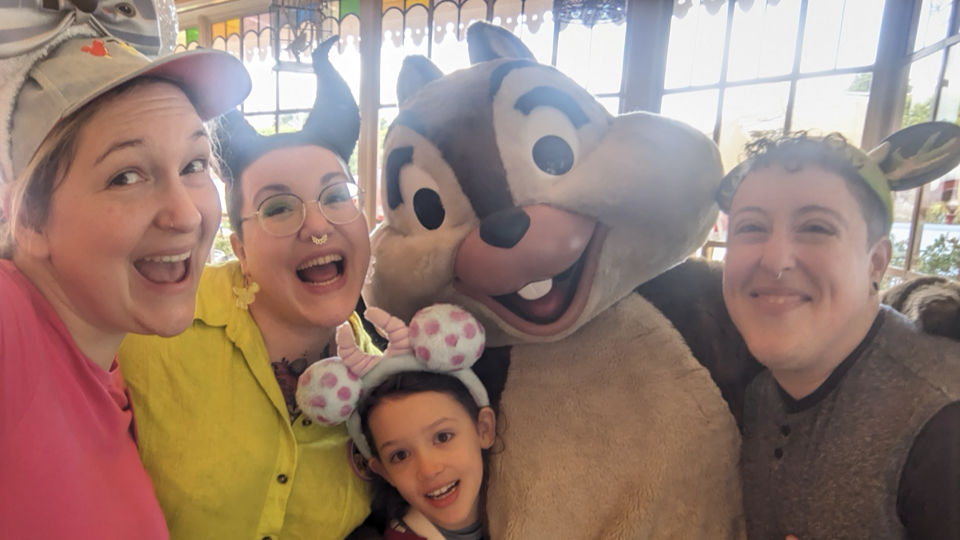
This story also influenced my decision, in 2024, to go to Disneyland for the first time, with Marcelle and Billy and Raimi, where I got to witness up close and personal the subversive ways children play within the frame of Disneyland as a space. And as I witnessed the hundreds of adults working to keep the massive machine of the theme park running, I thought about Joy again, and her purposelessness. Every other emotion has a function: to keep Riley safe, to develop her sense of fairness, to remind her that she is enmeshed in a web of interdependence. But Joy’s purpose is never named. Everywhere she goes, the many many workers in their unnecessary metaphorical hardhats, all agree that Joy must be returned to Headquarters. Riley is not perfectly malleable or perfectly knowable; she contains multitudes and she exceeds them. She is anarchic, chaotic, and queer. And she deserves Joy.
Works Cited
Bunch, Ryan. “Disney.” The SAGE Encyclopedia of Children and Childhood Studies, ed. Daniel Thomas Cook. SAGE Publications, 2020.
Halberstam, Jack [Judith]. The Queer Art of Failure. Durham and London: Duke University Press, 2011.
Kosman, Marcelle, and Raimi Marx. “Gender Euphoria.” Gender Playground, season 1, episode 1, Witch, Please Productions, 2024, https://www.materialgirlspod.com/gender-playground#seasonone.
“Pixar.” Wikipedia. https://en.wikipedia.org/wiki/Pixar. Visited on 28 April 2026.
Sammond, Nicholas. “Manufacturing the American child: child‐rearing and the rise of Walt Disney, Continuum.” Journal of Media & Cultural Studies 13:1(1999): 29-55. DOI:10.1080/10304319909365781.
Sandlin, Jennifer A. and Julie Garlen Maudlin. “Disney’s pedagogies of pleasure and the eternal recurrence of whiteness.” Journal of Consumer Culture 17.2 (2017): 397-412. https://doi-org.proxy.lib.sfu.ca/10.1177/14695405156023.
Schuller, Kyla. The Biopolitics of Feeling: Race, Sex, and Science in the Nineteenth Century. Durham and London: Duke University Press, 2018.
Stoler, Ann Laura. Carnal Knowledge and Imperial Power: Race and the Intimate in Colonial Rule. Berkley, Los Angeles, and London: University of California Press, 2002.